Quick Answer
To weld HDPE sheet, choose the method by joint type rather than by habit. Long, flat panel seams are normally made by heated-tool butt welding on a sheet butt welding machine: the edges are faced, clamped, heated against a plate, pressed together and cooled under pressure. The finished joint carries a bead on both faces. Structural corner and fillet joints, nozzles and repairs are made by extrusion welding, which deposits HDPE rod into a prepared groove. Hot air welding is often used for tacking, small details and thin material, and it can produce load-bearing joints when the joint design, rod and operator technique suit the procedure. HDPE is not joined by solvent cement, so welded HDPE fabrication relies on thermal welding, and joint quality depends on clean preparation, correct clamping, a procedure-defined temperature and pressure window, a fast changeover and full cooling under pressure.
HDPE is widely used in tanks, water treatment equipment, scrubbers, aquaculture systems and boat building. It is tough, chemically resistant and easy to machine, but it behaves differently from metals and from other plastics during welding. For a cross-material comparison that also covers PP and PVDF, see the multi-material sheet welding guide.
What Makes HDPE Different When You Weld It?
HDPE is a semi-crystalline thermoplastic. It does not melt at a single sharp temperature; it softens and melts over a range, and the crystalline regions need enough heat and time to melt completely. That has three practical consequences in the shop.
- The weld window is real but not generous. Too little heat leaves unmelted crystal structure and a weak joint; too much heat degrades the polymer and produces charring, bubbles and shrinkage stress. The usable window is defined by the material grade, the sheet thickness and the procedure, not by a number copied from another shop.
- Cooling is part of the weld. HDPE shrinks as it cools and develops residual stress if it is released early. A butt weld must stay under pressure until the joint has cooled enough to carry load. Releasing the clamps too early can leave the joint insufficiently supported during cooling and may contribute to distortion or later cracking.
- Surface condition matters. Contamination, dust, oil, surface moisture and heavily oxidised surfaces interfere with fusion. Freshly faced or freshly prepared surfaces weld more reliably than surfaces that have been sitting exposed.
The Three Methods for Welding HDPE Sheet
These three processes cover most industrial HDPE sheet fabrication work.
Heated-Tool Butt Welding
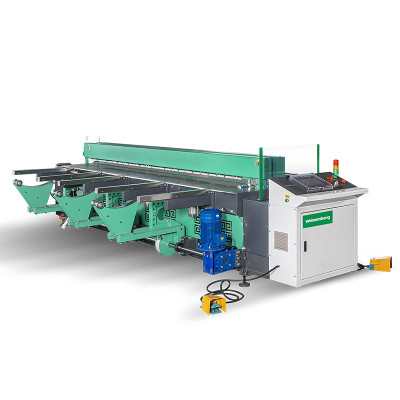
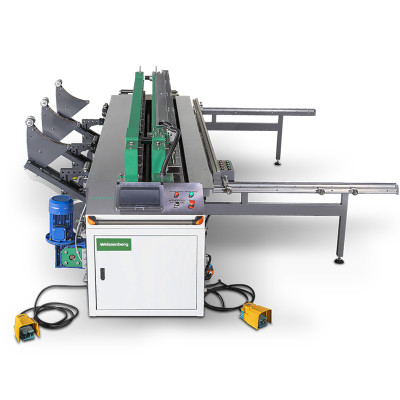
This is the production method for flat HDPE panels. The two sheet edges are clamped in a fixed and a moving carriage, machined flat by a facer, and then heated on both faces by a heating plate. When the melt bead reaches the size defined by the procedure, the plate is withdrawn and the carriage presses the edges together. The joint is made from the parent material with no filler, producing a butt weld with a bead on both sheet faces.
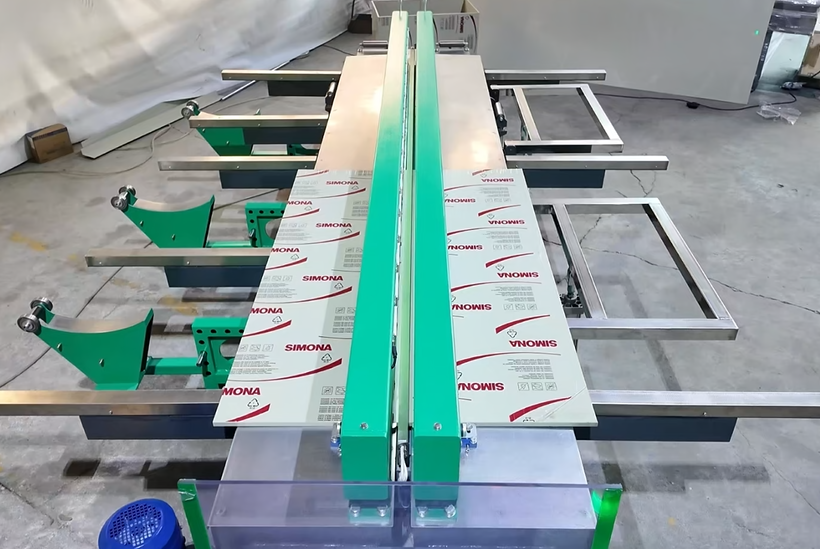
A flat-bed sheet butt welding machine faces, heats and joins HDPE panel edges along a straight seam.
Extrusion Welding
Extrusion welding is the method for joints that cannot be brought to a flat-bed machine. A hand extruder plasticises HDPE rod and deposits it into a groove or fillet, while a hot-air channel preheats the joint faces. It is used for tank corners, shell-to-bottom joints, nozzle and flange connections, repairs and field assembly.
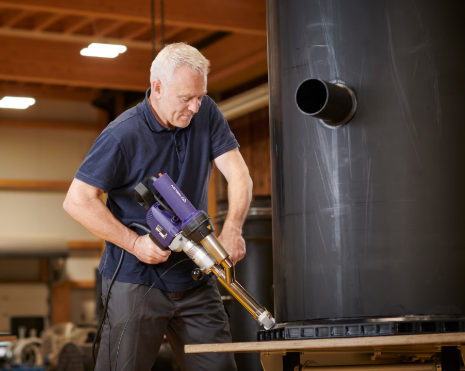
Extrusion welding builds corner, fillet and repair joints from HDPE rod rather than from the sheet edges themselves.
Hot Air Welding
Hot air welding uses a blower and a speed nozzle to soften the sheet surface and a hand-fed rod. It can produce structural joints when the root gap, rod feed, temperature and travel speed follow a qualified procedure, but on thick HDPE the joint is made by hand, penetration is harder to control, and the result depends heavily on operator technique.
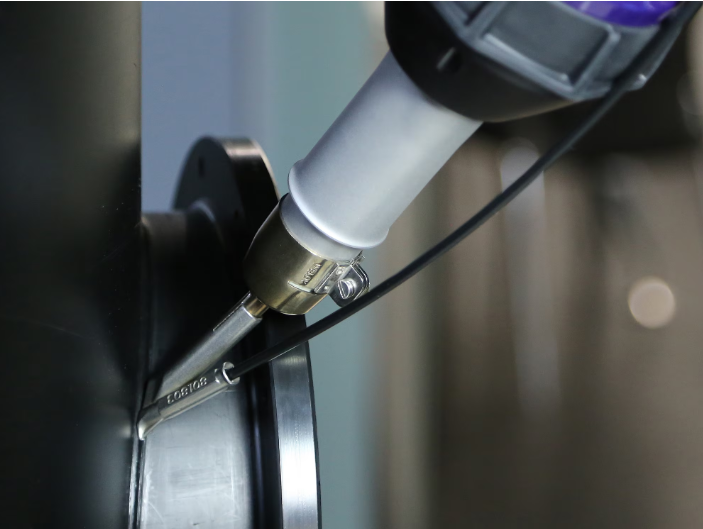
Hot air welding handles tacking, detailing and hand welding where a flat-bed machine cannot reach.
How to Weld HDPE Sheet by Butt Fusion: Step by Step
The butt welding cycle is short, but every step has a purpose.
- Check the sheet and the machine. Confirm the sheet grade, thickness and edge condition, and check that the machine is set up for that thickness. Remove dust and contamination from the weld zone.
- Clamp and align. Clamp both panels so the edges are parallel and the sheet faces are level. Alignment is checked before heating; a step between the two surfaces cannot be corrected by pressure later.
- Face the edges. Machine both edges with the facer until the cut is continuous and square. Facing removes contamination and creates the parallel faces the process needs.
- Insert the heating plate. Bring the plate to the temperature defined by the procedure and move the carriage until both edges touch it under the specified contact pressure.
- Form the bead and soak. Hold until a melt bead forms along both edges, then reduce to the heat-soak pressure and time so the melt zone develops through the sheet thickness.
- Change over quickly. Withdraw the plate and close the carriage within the allowed changeover time. This is the most time-critical step in the cycle.
- Join and hold. Apply the fusion pressure and hold it while the joint consolidates and the bead forms on both faces.
- Cool under pressure. Keep the clamps closed for the full cooling time. The joint is not finished when the machine stops moving; it is finished when it has cooled.
How Process Parameters Are Set
There is no universal parameter chart for HDPE sheet that can be applied to every machine and every grade. The values that matter — heater plate temperature, contact and heat-soak pressure, heating time, changeover time, fusion pressure and cooling time — are set by the qualified welding procedure for the specific material, thickness and machine. DVS 2207-1 covers heated-tool welding of PE pipes, pipeline components and panels, and the material supplier's data and the machine manufacturer's procedure provide the starting point.
Temperature
The heating plate must be hot enough to melt the sheet surface without degrading it. The set value comes from the procedure; a plate that is too cool produces incomplete fusion, and a plate that is too hot produces charring, smoke and a degraded melt zone.
Pressure and Time
Pressure has two jobs: it ensures contact between the sheet and the heating plate, and it drives the molten material together during joining. Higher pressure does not compensate for insufficient heat, and a longer heat time does not compensate for a misaligned joint.
Changeover and Cooling
The changeover time is the interval between removing the plate and closing the joint. If it is too long, the melt surface cools and oxidises, and the joint becomes a cold weld. Cooling time scales with sheet thickness; thick sections hold heat longer and must stay clamped longer.
Do not transfer parameters between machines. A setting that works on one machine, with one heating plate and one clamping system, is not automatically valid on another. Qualify the procedure on the machine that will run the work, and record the values that were used.
Common HDPE Weld Defects and What They Mean
Many HDPE weld defects are process defects rather than material defects. The table below maps what you see to the checks worth making first.
For a wider defect library that covers PP and PVDF as well, see common plastic sheet welding defects and how to fix them.
Choosing Equipment for HDPE Sheet Fabrication
The machine has to match the work, not the other way around. Five specifications decide most of the fit.
- Working width. The bed length determines the longest seam you can make in one pass.
- Thickness capacity. The machine must be rated for the sheet thickness you actually weld, not the average. Thick sheet needs more heating and cooling time and a stiffer clamping system.
- Heating plate. Weissenberg's sheet butt welders use a single-zone heating plate; where a model's published data specifies it, temperature uniformity is stated as ±5 °C. The plate must be flat, clean and temperature-checked.
- Clamping and alignment. Rigid clamps and a straight bed matter more than extra features.
- Control and options. On appropriately configured CNC models, programmed cycles and parameter recording can improve repeatability and traceability. A 90° vertical option or a combined welding and bending bed can remove handling steps, but only if the work justifies it.
As a reference point in the current range, the WeiBond 1500 is a 1500 mm-wide sheet butt welder rated for up to 15 mm welding thickness (3–15 mm per the product description) and built to DVS 2207. Larger beds and other configurations cover different panel sizes and thicknesses; the plastic sheet butt welder category lists the current models and specifications.
Quality Checks Before the Sheet Leaves the Shop
- Visual inspection. Check bead size and symmetry, alignment, discolouration and surface damage against the acceptance criteria in the procedure.
- Coupon testing. Weld a sample with the same material, thickness and settings, and test it. A bend test or macro section shows fusion through the thickness in a way that a visual check cannot.
- Dimensional check. Confirm panel size, squareness and flatness after cooling, especially on large assemblies where shrinkage accumulates.
- Leak testing. For tanks and vessels, test the finished assembly according to the project specification before it leaves the shop or goes into service.
- Records. Record the machine, procedure, material batch and operator for traceability.
Where HDPE Sheet Welding Is Used
HDPE sheet fabrication covers chemical and water storage tanks, water treatment and dosing equipment, scrubber housings and ductwork, aquaculture tanks, HDPE boats and pontoons, and liners for ponds and containment areas. The HDPE chemical tank fabrication guide covers the tank-specific workflow in more detail.
Frequently Asked Questions
Can HDPE sheet be welded without a butt welding machine?
Yes, for some joints. Extrusion welding and hot air welding can join HDPE without a flat-bed machine, and both are essential for corners, nozzles and site work. What they do not replace is the long, straight, full-penetration seam with a bead on both faces that a sheet butt welder produces efficiently. Many fabrication shops use both: a butt welder for long panel seams and an extruder for corners, nozzles and assembly work.
Can HDPE be glued or solvent-welded instead of welded?
No. HDPE is a non-polar polyolefin and does not dissolve in the solvents used for PVC and similar plastics, so solvent cementing is not a structural joining method for it. Adhesive bonding is possible with specialised surface treatment and adhesives, but it is a different engineering route with its own limitations. For tanks and process equipment, thermal welding is the standard method.
How thick can HDPE sheet be welded?
It depends on the machine and the qualified procedure. In the current Weissenberg range, the WeiBond 1500 is rated for up to 15 mm welding thickness (3–15 mm per the product description); the WeiBond 2000 to 7000 models cover different welding widths. Thick sheet is not simply a matter of more heat: heating, changeover and cooling times all increase, and the clamping system must hold the section flat. Always confirm the rating for the exact model before specifying the work.
Why does an HDPE weld look good but still leak?
A good-looking bead shows that material reached the joint faces; it does not prove that fusion happened through the full thickness. A cold weld, contamination or incomplete penetration can produce an acceptable-looking bead with a weak or porous core. That is why coupon testing and leak testing exist. Visual inspection is the first check, not the only one.
Do I need a CNC sheet butt welder?
Not necessarily. A manual or semi-automatic machine can produce good work in the hands of a trained operator following a qualified procedure. CNC control becomes valuable when you need repeatability across many panels, recorded parameters or consistent cycles with less dependence on operator judgement. The decision should follow production volume and quality requirements, not the feature list alone.
Selection Checklist and Next Step
- List the joint types in the job: long panel seams, corners, nozzles, repairs.
- Confirm the HDPE grade and the full thickness range, not just the nominal sheet.
- Decide which joints must be made on a flat-bed machine and which will be extruded on site.
- Match the machine working width and thickness capacity to the largest panel you actually produce.
- Qualify the welding procedure on the machine and material you will use, and record the parameters.
- Define the inspection level: visual, coupon, dimensional and leak testing as the duty requires.
Need help matching a machine to your HDPE work? Send Weissenberg the sheet grade, thickness range, typical panel size and the joint types in the job. The team can confirm the working width, thickness capacity and configuration that fit the fabrication, and explain which joints are better made by butt fusion, extrusion or hot air welding.